The Weight We Carry in Silence: Survivor’s Guilt, Strength, and the Inner Lives of Black Men
By Dr. Ifeanyi Ufondu, Clinical Psychologist and founder of BroKin.Org Mental Health Solutions
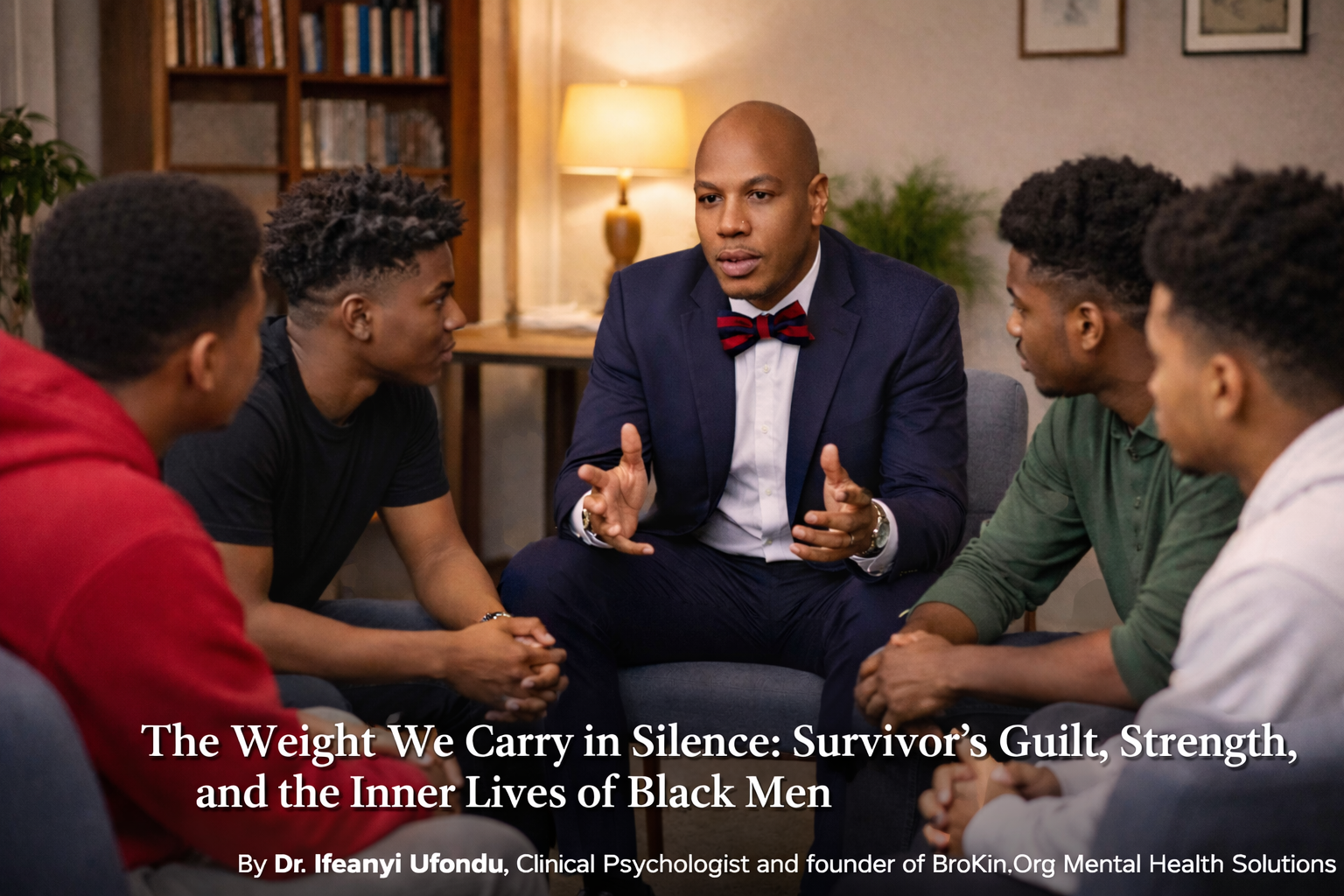
In my clinical work at **BroKin.Org Mental Health Solutions**, I sit across from Black men every week who appear successful by every visible metric. Some are executives. Some are former athletes. Some are fathers working two jobs. Some are young men who “made it out” of neighborhoods where many of their friends did not.
On the surface, they are composed. Productive. Dependable. Respected.
But when the room gets quiet enough and the guard comes down, a different story emerges.
I often hear some version of this sentence:
Doc, I feel guilty for doing well when people I grew up with are struggling, locked up, or dead.
This is not simple stress.
This is not just pressure.
This is a clinically recognizable pattern that blends **survivor’s guilt, racialized stress, and unresolved trauma**.
And it is far more common among Black men than many realize.
The Hidden Psychology of “Making It Out
For many Black men, upward mobility is not just personal success — it is collective responsibility. When one man rises, he often feels he carries ten others on his back.
Clinically, this creates what I describe as **dual-conscious pressure**:
1. The pressure to succeed in mainstream spaces
2. The pressure to remain loyal and accessible to one’s community of origin
This psychological tension can create:
* Chronic anxiety
* Hypervigilance about money and status
* Difficulty saying no to financial requests
* Fear of being perceived as “changed”
* Emotional burnout from over-giving
* Depression masked as irritability or detachment
Many men do not name this as distress.
They call it “handling business.”
But the body and mind keep score.
Cultural Context Matters
A culturally competent lens is not optional here — it is essential.
Black men in America are navigating:
* Generational poverty trauma
* Historical exclusion from wealth-building
* Racial profiling and social threat
* Community violence exposure
* Systemic inequities in education and employment
* Family systems shaped by survival, not emotional processing
When a Black man becomes the “one who made it,” he often becomes:
* The lender
* The problem solver
* The family therapist
* The emergency contact
* The symbol of hope
That is a heavy psychological load for any human being.
Without culturally informed therapy, this burden gets mislabeled as simple stress or poor boundaries. In reality, it is often **trauma-informed guilt rooted in collective experience.**
Emotional Suppression as a Survival Skill
Many Black boys are socialized early to equate vulnerability with danger.
I hear men say:
* “I learned early nobody was coming to save me.”
* “Crying wasn’t an option where I grew up.”
* “Showing emotion got you clowned or targeted.”
From a clinical standpoint, emotional suppression can be adaptive in unsafe environments. It helps a child survive.
But what protects a boy can quietly harm the man.
Long-term emotional suppression is associated with:
* Hypertension
* Sleep disturbances
* Substance misuse
* Emotional detachment in relationships
* Explosive anger episodes
* Internalized depression
Many Black men are not emotionless.
They are emotionally armored.
Redefining Strength Through a Clinical Lens
In therapy, one of the first reframes I offer is this:
**Strength is not the absence of emotion.
Strength is the ability to face emotion without being ruled by it.**
Clinically, real resilience includes:
* Emotional literacy
* Boundary-setting without guilt
* Trauma processing
* Self-compassion
* Secure attachment development
* Identity work beyond productivity
When men begin this work, something powerful happens.
They become less reactive.
More present.
More intentional.
More at peace.
And importantly — they learn they do not have to carry everyone alone.
A Clinical Truth Many Need to Hear
You can love your community
without sacrificing your mental health.
You can help others
without rescuing everyone.
You can succeed
without apologizing for it.
And you can honor where you came from
while still evolving beyond it.
Therapy is not about disconnecting from your roots.
It is about engaging them in a healthier way.
What Healing Looks Like in Practice
At BroKin.Org Mental Health Solutions, healing often starts with:
* Naming survivor’s guilt
* Processing early trauma exposure
* Rebuilding identity beyond struggle
* Learning culturally relevant coping tools
* Developing boundaries rooted in self-respect, not shame
* Creating space for joy without guilt
Healing is not instant.
It is layered.
It is courageous.
And it is deeply human.
A Message to Black Men Reading This
If you’ve ever felt:
* Guilty for outgrowing your environment
* Pressured to be the strong one
* Tired of carrying others emotionally or financially
* Unsure who you can talk to safely
You are not alone.
And nothing about that makes you weak.
It makes you human.
Seeking support is not a betrayal of your culture.
It is an investment in your longevity.
Final Reflection
One healed Black man can shift an entire family system.
One emotionally aware father can change a generation.
One man choosing peace can influence a community.
Your healing is bigger than you.
And you deserve that healing.
Dr. U