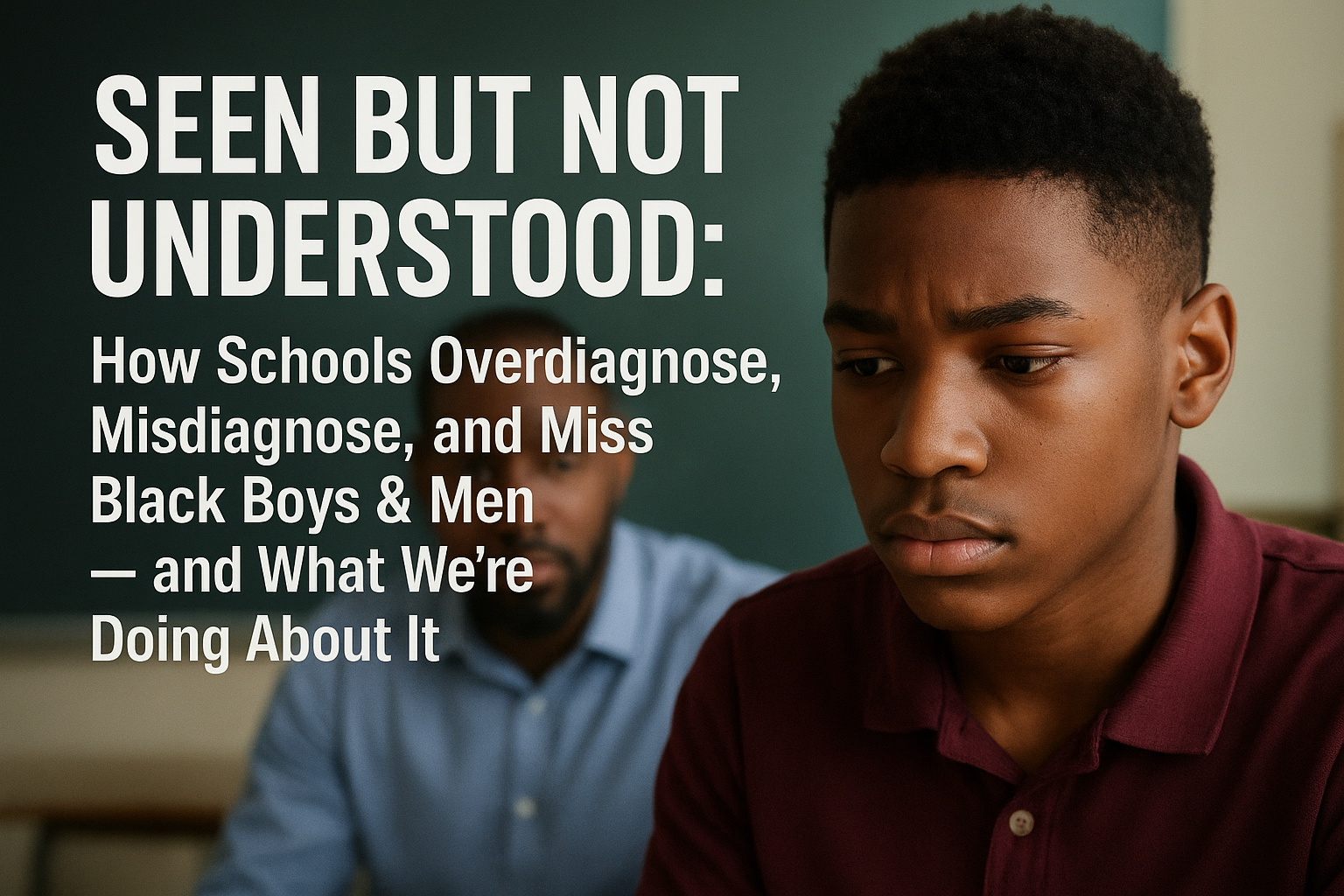
“Seen but Not Understood”: How Most Schools Overdiagnose, Misdiagnose, and Miss Black Boys & Men — and What We’re Doing About It
“Seen but Not Understood”: How Schools Overdiagnose, Misdiagnose, and Miss Black Boys & Men — and What We’re Doing About It
By Dr. Ifeanyi Ufondu, Clinical Psychologist, BroKin.org
I’ve sat across from too many Black boys and young men who’ve been told they are a “problem” before anyone asked them a single curious question. In school hallways from South LA to Dallas–Fort Worth, I’ve watched how a Brotha’s stress response gets labeled as a disorder, how grief looks like “defiance,” and how brilliance gets buried under paperwork. This isn’t just bad practice; it’s a pipeline—one that reroutes potential into probation, creativity into containment, and trauma into “noncompliance.”
This piece is about two intertwined crises:
-
Overdiagnosis and misdiagnosis of developmental/behavioral disorders among Black boys and young men in school systems, and
-
Non-diagnosis—the silent overlooking—of Black males living in chronic survival mode due to neighborhood risk, economic stress, racism, and grief.
Both distortions rob our students of the right supports, the right language, and the right futures.
The Diagnostic Blind Spot: When Survival Mode Looks Like a “Disorder”
When you grow up in conditions that demand constant vigilance—sirens at night, unstable housing, inconsistent food, a parent working two jobs, police helicopters buzzing—your nervous system adapts. Hypervigilance, guarded eye contact, irritability, and fidgeting are not “bad behaviors.” They are survival strategies.
Here’s the trap: survival responses can look like ADHD, ODD (Oppositional Defiant Disorder), or Conduct Disorder in a 15-minute classroom snapshot. Without a trauma-informed lens, we pathologize adaptations that once kept a child safer.
“When I slowed down and asked what he was protecting, not what he was resisting, everything changed.”
— Mr. Anthony Johnson, veteran LAUSD teacher and BroKin.org community ally
What gets missed:
-
Trauma-related hyperarousal mistaken for ADHD.
-
Traumatic grief (after losing a friend or loved one) mistaken for depression alone, without addressing persistent danger cues.
-
Anxiety and sleep disruption from neighborhood stress misread as “lack of motivation.”
-
Masking in autism—especially among Black boys—misinterpreted as intentional defiance or social “attitude,” leading to missed ASD evaluations.
Overdiagnosis, Misdiagnosis… and the Wrong Interventions
I routinely review files where Black boys are labeled early and broadly—then placed on behavior plans that punish symptoms instead of treating causes.
Common patterns I see:
-
ADHD vs. Complex Trauma: Both can present with inattention and impulsivity. Without a full developmental and psychosocial history, trauma screens, and teacher/parent multi-context ratings, ADHD is over-called, trauma under-treated.
-
ODD as a Catch-All: ODD becomes the bucket when a child “talks back,” “doesn’t comply,” or protects his dignity in the face of disrespect. ODD is a diagnosis; dignity is a need.
-
ASD Under-Recognition: Black boys with autism are more likely to be identified later and mischaracterized as “behavioral.” Subtle social communication differences + cultural code-switching can hide in plain sight.
-
Language & Learning Disorders Overlooked: If a student is disciplined often, schools sometimes stop testing—assuming “behavior first.” Meanwhile, specific learning disorders and language disorders remain unaddressed, fueling more frustration.
“Too often the intervention is consequence, not care. We write referrals when we should be writing safety plans.”
— Dr. Renee Matthews, Dallas–Fort Worth school psychologist and BroKin.org referral partner
The Non-Diagnosis Crisis: Boys Who Disappear in Plain Sight
There’s another group I worry about: the quiet Black boys who rarely explode in class, who withdraw, who carry family responsibilities most adults would buckle under. These Brothas are under-identified for depression, anxiety, or trauma—not because they’re fine, but because they’ve become experts at making adults comfortable.
What to look for:
-
Sudden drop in grades after a community loss or violent event
-
Exhaustion from work obligations, caregiving of siblings, or night-time hypervigilance
-
Somatic complaints (stomachaches, headaches) without medical findings
-
Perfectionism masking anxiety—“If I fail, I’m finished” logic common among students under economic or immigration stress
-
Social isolation or “I’m good” stoicism, especially after ridicule or racial microaggressions
“Some of our strongest kids are in silent collapse. They’re compliant, so they get ignored.”
— Coach Marcus Henderson, South Los Angeles youth mentor and long-time BroKin.org collaborator
Structural Roots: It’s Not the Kid—It’s the Context
We can’t separate the child from the ecosystem. Disproportionate discipline, biased screening referrals, underfunded schools, limited access to culturally competent clinicians, and teacher burnout all feed the diagnostic distortions.
Where the system breaks:
-
Referral bias: Teachers under pressure refer for “behavior” before consulting MTSS/RTI supports.
-
Time poverty: Counselors carry caseloads that make thorough histories feel impossible.
-
Assessment mismatch: Tools normed on majority populations miss culturally shaped expressions of distress.
-
Family-school trust gaps: Prior negative experiences with systems lead families to decline testing or disengage—especially if the first contact is punitive.
“If the first time the school calls me is to say ‘your son’s a problem,’ why would I trust your evaluation?”
— Mrs. LaTasha Green, Dallas parent advocate and BroKin.org family council leader
Differential Diagnosis Done Right: Dr. Ufondu’s Protocol
At BroKin.org, our standard is simple: Slow is smooth, and smooth is fast. Precision up front prevents years of incorrect labels.
Our evaluation steps include:
-
Whole-Story Intake (Not Just a Form)
-
Trauma & Grief Screening First
-
Context Mapping
-
Functional Behavior Assessment with Dignity
-
Academic & Language Testing
-
Culturally Responsive Observation
-
Team Huddle Synthesis
“When we adopted Dr. Ufondu’s BroKin’s protocol, our campus moved from punishment to partnership. Referrals dropped; plans got smarter.”
— Dr. Sheila Parker, Assistant Principal, Arlington ISD
What Schools Can Do This Semester
-
Shift from compliance to nervous-system care
-
Require true MTSS pathways before special ed referrals
-
Adopt culturally responsive tools
-
Differentiate ADHD from trauma/sleep debt
-
Make families co-authors, not guests
-
Protect dignity in discipline
-
Screen the invisible
“Once we stopped taking ‘I’m good’ at face value, we saved lives—literally.”
— Lieutenant Darrell Williams, Dallas Police Department SRO and BroKin.org partner
From Labels to Liberation
Diagnosis should be a key—not a cage. The right name can unlock services, compassion, and a personalized roadmap. The wrong name can lock a child into the role of “problem,” changing how adults look at him—and how he looks at himself.
At BroKin.org, we teach students language that returns power:
-
“My nervous system is loud today.”
-
“I need a 3-minute reset.”
-
“I’m not refusing; I’m overloaded.”
“Give a child the right words for their experience, and you just gave them a future.”
— Dr. Ifeanyi Ufondu
Our Commitment
We’re deep in the work across Los Angeles and Dallas–Fort Worth—training teachers, partnering with school police on de-escalation rooted in dignity, evaluating students with whole-story methods, and walking with families who’ve been burned before. We don’t chase quick labels. We build long-term capacity in schools so fewer Black boys are miscast, and more are accurately supported—in learning, in healing, and in purpose.
If your campus, district, or community group is ready to move from compliance to care, from labels to liberation, BroKin.org is ready to partner.