“Stuck in 2026: A Psychological Autopsy of the Modern Black Man”
By Dr. Ifeanyi Ufondu, Clinical Psychologist and founder of BroKin.Org Mental Health Solutions
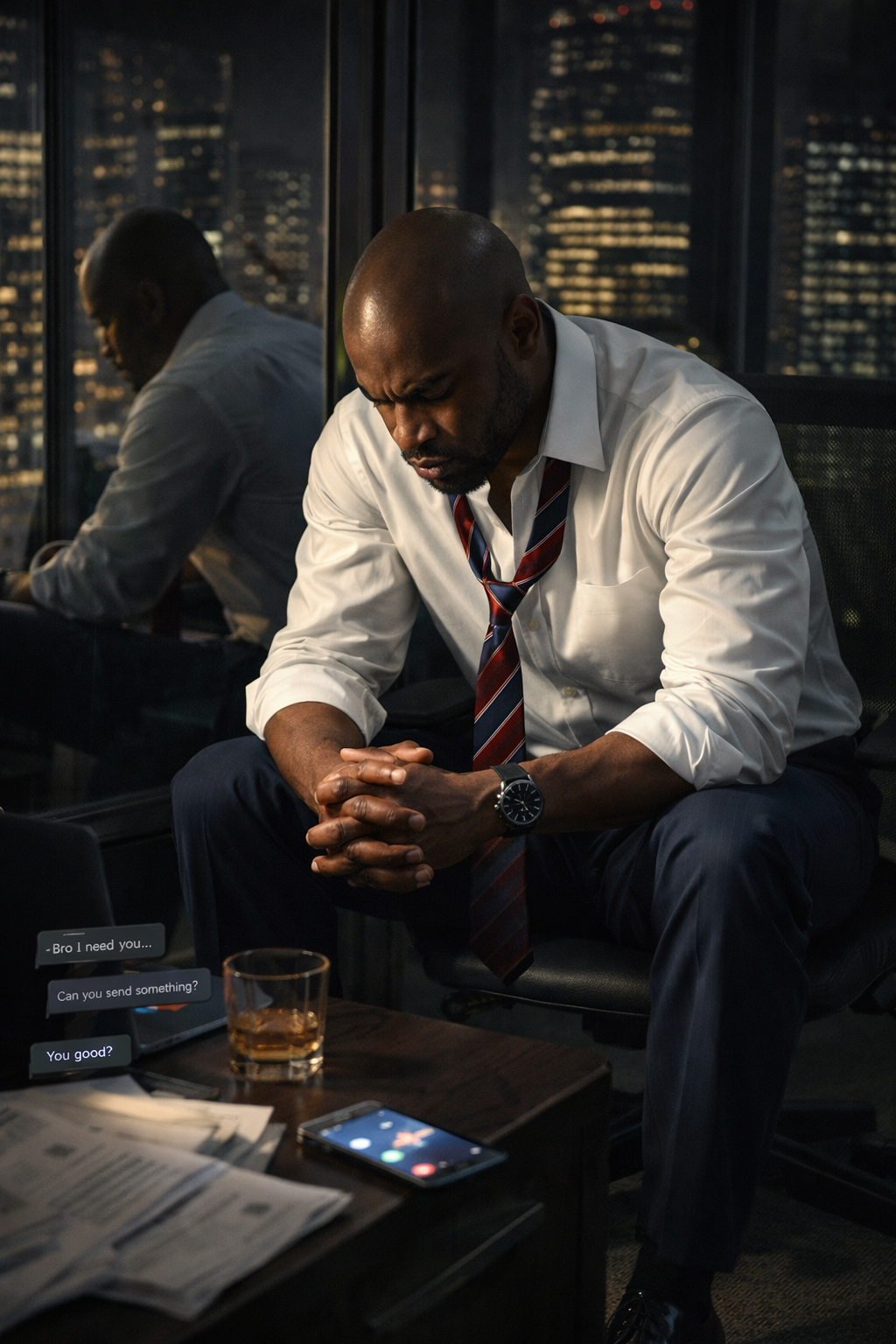
He sat across from me, composed on the surface, but I could see it in his eyes before he even said a word. Mid-30s. Educated. No obvious signs of dysfunction. The kind of brother society would look at and say, “He’s doing well.”
But when I leaned in and asked him how he was really doing, he let out a breath that felt like it had been sitting in his chest for years.
“Doc… I feel stuck.”
Not depressed in the way people imagine. Not falling apart. Just… stuck. Like life had him on pause while everything else kept moving.
And I’ve been hearing that word more than ever in 2026.
As a clinician, I don’t dismiss language like that. Words are data. And “stuck” is not just a feeling—it’s a psychological condition. It’s what happens when a man has the capacity to move, but something—internal, external, or both—keeps him from doing it.
What I’m seeing right now among Black men isn’t isolated. It’s a pattern, shaped by the times we’re living in.
There’s a certain weight in the air these days. You don’t even have to watch the news like that—you feel it. The political climate has a way of creeping into your nervous system whether you invite it or not. Policies shift, conversations about rights get louder, tensions stay high, and as a Black man, you don’t get the luxury of being unaware. You’re calculating. You’re reading the room. You’re adjusting your tone, your presence, your movements.
That kind of awareness isn’t just intelligence—it’s survival. But when survival mode becomes your baseline, it changes you. You get sharper, but also more guarded. More alert, but also more tired. And over time, that constant scanning turns into something deeper than stress. It becomes exhaustion that sleep can’t fix.
Now layer that with the reality of the job market. On the surface, it looks like opportunity is everywhere. But the brothers sitting in my office will tell you a different story. Jobs don’t feel secure. Layoffs come out of nowhere. Salaries don’t stretch the way they used to. So now you’ve got men who are grinding every day, checking all the boxes they were told to check, but not seeing the return.
That disconnect does something to a man’s psyche. When effort stops producing expected outcomes, the brain starts recalibrating. It begins to question the value of the effort itself. That’s when you start hearing thoughts like, “What’s the point?” Not because he’s lazy, but because his mind is adapting to repeated disappointment.
Then there’s housing. Something as fundamental as having a place to call your own has become a psychological battleground. For many Black men, homeownership was never just about property. It was about stability, about legacy, about planting a flag that said, “I made it, and I can provide.” But in 2026, that door feels harder to reach than ever.
So what happens when a man can’t access something he’s been conditioned to associate with success and manhood? He may not say it out loud, but internally, it lands as failure. It chips away at his confidence, not because he lacks capability, but because the system he’s operating in isn’t yielding what it once promised.
And just when he needs peace the most, relationships often don’t feel like refuge anymore. We’re living in a time where connection is constant, but genuine intimacy feels rare. Social media has distorted expectations, amplified comparison, and made relationships feel more like performance than partnership.
I sit with men who want to love, who want to build, but feel like they’re walking into emotional minefields. They don’t feel heard. They don’t feel safe enough to be vulnerable. So they pull back. Not out of apathy, but out of self-preservation. And that distance, while protective, reinforces the isolation that feeds the feeling of being stuck.
What complicates all of this is how many of us were raised. There wasn’t a lot of room for emotional language. You didn’t sit around labeling anxiety or unpacking trauma. You handled it. You pushed through. You figured it out.
So now you’ve got grown men experiencing very real psychological distress, but without the vocabulary to name it. Depression gets called “being tired.” Anxiety gets labeled “stress.” Trauma gets brushed off as “just life.” That mislabeling keeps the problem in the dark, and anything that stays in the dark has power.
From where I sit, being “stuck” is not weakness. It’s not a lack of drive. It’s what happens when chronic stress, limited control, and unprocessed experiences collide. It’s a protective state. The mind and body essentially say, “If the environment isn’t responding the way we need it to, we’re going to slow this whole thing down.”
The problem is, what starts as protection can become confinement.
So the question becomes: how does a man move again?
It doesn’t start with some loud, motivational breakthrough. It starts quieter than that. It starts with reclaiming control in the places where it still exists. Because even in a system that feels unpredictable, there are pieces of your life that are yours. Your structure. Your discipline. Your choices. When a man begins to establish consistency in those areas, even in small ways, something powerful happens—he rebuilds trust in himself.
But before any of that can take root, there’s another layer that has to be addressed. You can’t build effectively if your nervous system is stuck in survival mode. I’ve had to walk brothers through something as simple—and as profound—as learning how to slow their breathing, how to sit still without distraction, how to move their bodies in ways that release tension. It sounds basic, but it’s foundational. You can’t think clearly if your body is in a constant state of alarm.
Then comes the work most men try to avoid—the emotional excavation. The old wounds. The childhood experiences. The betrayals that were never processed, just buried. Those things don’t disappear. They show up in decision-making, in relationships, in self-sabotage. And until they’re addressed, they quietly keep a man in place.
This is where culturally competent therapy becomes critical. Not just someone listening, but someone who understands the context, who can challenge you, reframe your thinking, and help you build a strategy forward. At BroKin™, that’s the work. It’s not about sitting in pain—it’s about making sense of it and then moving with intention.
I also tell my clients this, and I don’t sugarcoat it: you cannot heal in environments that keep you sick. The people around you, the conversations you entertain, the content you consume—it all matters. If your environment reinforces stagnation, it doesn’t matter how motivated you feel in the moment. You’ll get pulled right back.
And finally, there’s a shift that has to happen internally. A lot of men are trying to escape the feeling of being stuck. They distract themselves, numb it, avoid it. But real change doesn’t come from escape. It comes from construction.
Building something. A skill. A routine. A new way of thinking. Something that creates forward motion, even if it’s incremental.
Because movement—real, intentional movement—is what breaks stagnation.
I tell the brothers I work with the same thing I’ll say here.
You’re not crazy for feeling stuck right now. You’re not weak. You’re not behind.
You’re aware.
You’re responding to a world that is, in many ways, unstable and demanding in ways previous generations didn’t have to navigate in the same form.
But awareness without action can turn into a trap.
And the goal isn’t just to understand why you feel the way you feel.
The goal is to move differently because of it.
From my chair to yours, I’ll leave you with this:
You may feel stuck right now. But that is a state, not a sentence.
And with the right tools, the right environment, and the willingness to do the work, you don’t just get unstuck.
You evolve.
Love, Light and Ovastanding,
Dr. U