“Love Under Fire: Dr. Ufondu and The Psychology Behind the Gender War Between Black Men and Women Online”
By Dr. Ifeanyi Ufondu, Clinical Psychologist and Founder of BroKin.Org
There’s a new civil war unfolding — not in the streets, but in our comment sections.
Scroll through Instagram or YouTube for just five minutes, and you’ll see it: the battle of the sexes, the endless duels between men and women dissecting love, infidelity, submission, leadership, and loyalty.
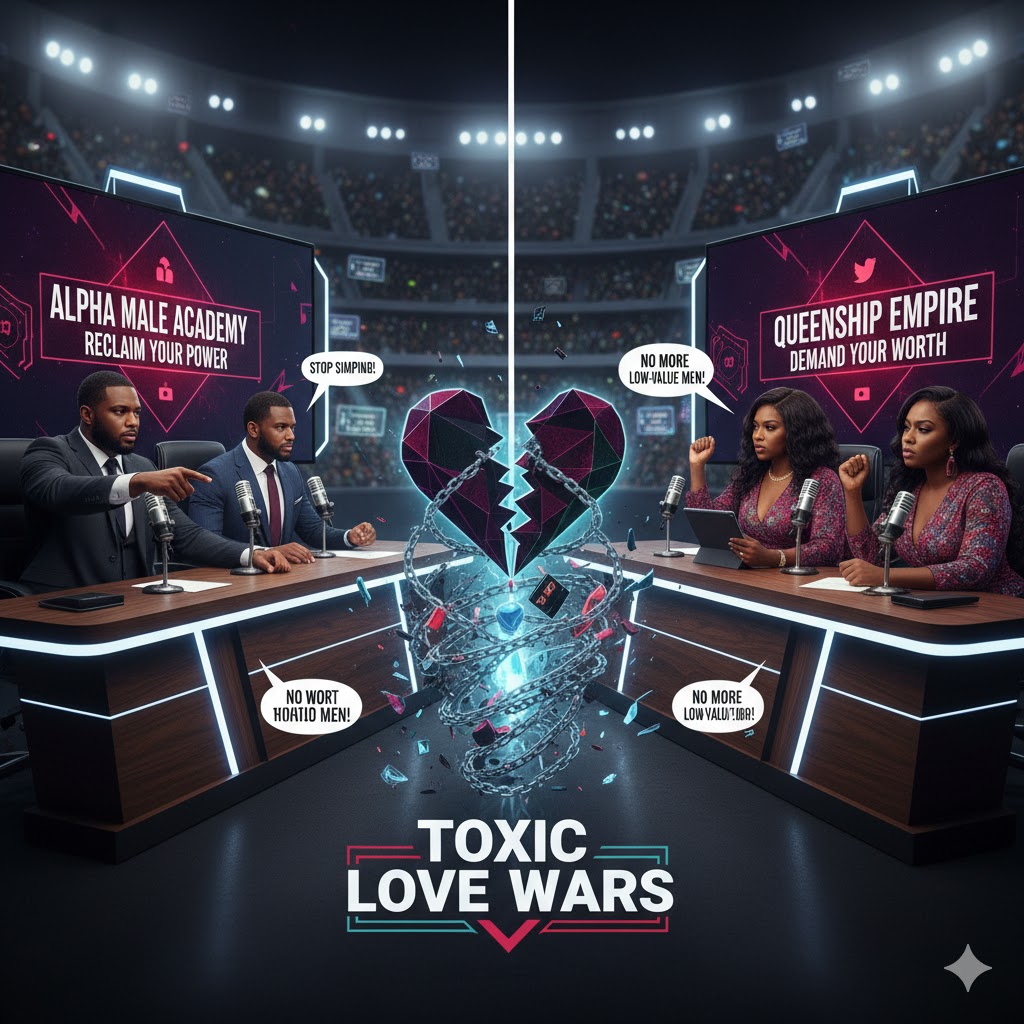
From viral clips on Tonight’s Conversation to podcast debates on “what a real man should do” or “why modern women aren’t wife material,” we’re witnessing something deeper than entertainment — we’re witnessing a cultural cry for connection disguised as combat.
The Digital Battlefield of Broken Hearts
What’s being played out across social media isn’t just content — it’s trauma choreography.
Every clip, every debate, every viral quote is a symptom of deeper pain.
When I analyze this phenomenon as a psychologist, I don’t just see men and women arguing.
I see two generations of hurt people trying to prove their worth to a camera because they never had a safe space to prove it to each other.
Our social media algorithms now feed us not love, but confirmation bias.
They curate heartbreak, amplify resentment, and reward outrage.
In the process, the very communities that should be healing each other are now performing their pain for public applause.
The Rise of the “Relationship Guru”
In this new digital economy, trauma has become content, and pain has become profit.
Many of these so-called “relationship gurus” — whether male or female — aren’t offering healing; they’re offering emotional entertainment.
When a man says, “Black women don’t respect good men,” or a woman says, “Black men can’t lead,” what they’re really saying is: “I haven’t healed from who hurt me.”
But because the internet rewards extremes, those soundbites go viral while nuance dies in silence.
We’ve replaced communication with performance.
We no longer talk to each other — we talk at each other, through microphones, ring lights, and podcast studios.
Cultural Trauma Dressed as Modern Debate
From a clinical perspective, what we’re witnessing is intergenerational trauma dressed up as trending content.
Centuries of broken Black families, systemic emasculation, overburdened Black women, and unhealed childhood attachment wounds are all colliding in digital spaces where validation is currency.
What looks like a “gender war” is really a public reckoning with private pain.
When a Black man yells, “We don’t feel appreciated,”
and a Black woman yells, “We’re tired of carrying everything,”
those are not opposing statements.
Those are parallel truths rooted in survival.
But social media doesn’t reward healing — it rewards hostility.
The Psychology of Projection
Much of what’s happening in these digital debates is projective identification — a defense mechanism where we assign our unhealed pain to the opposite gender.
A man who grew up unseen by his mother may internalize that as “Black women don’t care about us.”
A woman who’s been abandoned by her father or betrayed by past partners may conclude “Black men can’t be trusted.”
Both are protecting the inner child within them — the one who needed love but received disappointment.
Online, these unhealed identities clash in a cycle of projection, blame, and retaliation.
Each side points the finger at the other, never realizing they’re staring at a mirror.
Toxic Love as Entertainment
The biggest casualty of this gender war isn’t just love — it’s empathy.
We’ve learned to laugh at heartbreak, meme our loneliness, and monetize dysfunction.
Entire shows now build audiences off the spectacle of Black relationships breaking down in real-time.
But behind every viral debate is a truth we’re afraid to face: we’re watching ourselves unlearn love in front of millions.
“Every clip of two people yelling about relationships is really two wounded souls trying to convince the world that their pain has meaning.” — Dr. Ifeanyi Ufondu
Reclaiming Emotional Literacy
The cure to this digital sickness isn’t silence — it’s emotional literacy.
We have to teach our people how to identify, articulate, and heal from their pain before they perform it.
Healing looks like Black men learning that vulnerability isn’t weakness.
It looks like Black women realizing that protection doesn’t mean control.
It looks like choosing conversation over competition.
As I tell my clients at BroKin:
“You can’t build intimacy where there’s still an audience.”
Love isn’t a debate topic. It’s a practice — one that requires grace, humility, and repair.
The Way Forward
We need to detox from algorithmic anger and return to human connection.
Our people don’t need more “relationship debates.” We need relationship rehabilitation.
Let’s start asking the harder questions:
-
What would happen if we replaced viral debates with actual dialogue?
-
How much pain are we performing instead of processing?
-
And who benefits when Black love becomes a spectacle instead of a sanctuary?
Because if we don’t change course, the war between Black men and women won’t just stay online — it’ll erode the foundation of our families, our children, and our collective peace.
“Healing is not trending, but it’s timeless.” — Dr. Ifeanyi Ufondu
“The real relationship conversation starts when the cameras turn off.” — Dr. Ifeanyi Ufondu
Final Reflection
What we’re seeing across Instagram and YouTube isn’t the death of love — it’s a generation’s desperate attempt to redefine it in real time.
But we cannot build connection on top of unhealed trauma.
Until we learn to listen — really listen — to each other’s pain without performing for an audience, love will remain entertainment instead of evolution.
At BroKin.Org, we’re committed to changing that — one conversation, one brother, one sister at a time.
Love isn’t a debate topic. It’s a practice — one that requires grace, humility, and repair.
The Way Forward
We need to detox from algorithmic anger and return to human connection.
Our people don’t need more “relationship debates.” We need relationship *rehabilitation.*
Let’s start asking the harder questions:
* What would happen if we replaced viral debates with actual dialogue?
* How much pain are we performing instead of processing?
* And who benefits when Black love becomes a spectacle instead of a sanctuary?
Because if we don’t change course, the war between Black men and women won’t just stay online — it’ll erode the foundation of our families, our children, and our collective peace.
- “Healing is not trending, but it’s timeless.” — Dr. Ifeanyi Ufondu
- > “The real relationship conversation starts when the cameras turn off.” — Dr. Ifeanyi Ufondu
Final Reflection
What we’re seeing across Instagram and YouTube isn’t the death of love — it’s a generation’s desperate attempt to redefine it in real time.
But we cannot build connection on top of unhealed trauma.
Until we learn to listen — really listen — to each other’s pain without performing for an audience, love will remain entertainment instead of evolution.
At BroKin.Org, we’re committed to changing that — one conversation, one brother, one sista at a time!