Survival, Ego, and Mean Muggin’: Unpacking Why Black Men Hate Instead of Congratulate
By Dr. Ifeanyi Ufondu, Clinical Psychologist and Founder of BroKin.Org
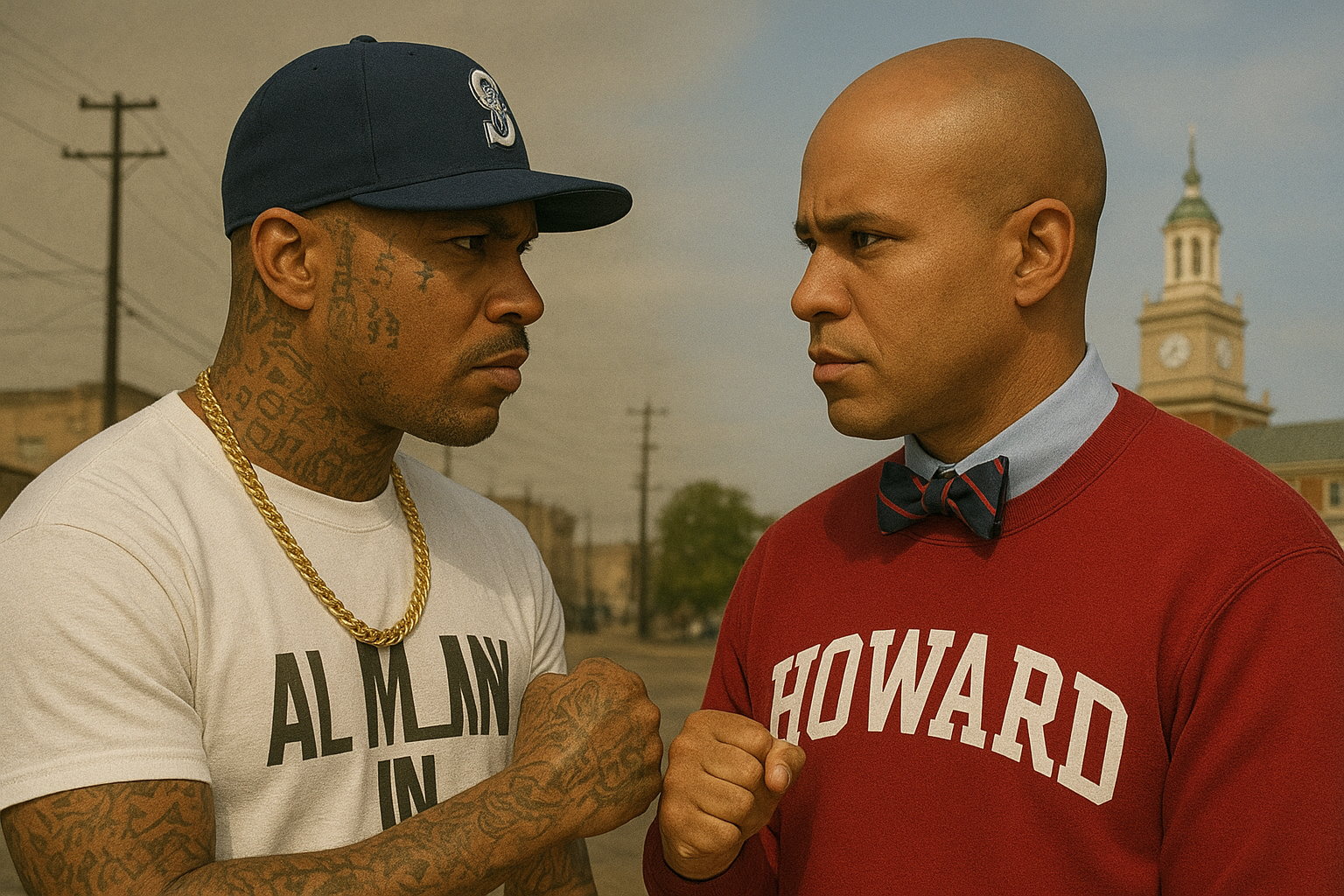
There’s a moment every Black man knows all too well — that quick, silent exchange when you lock eyes with another Brotha. It’s not a word spoken, but something shifts in the air. A vibe change! You square your shoulders up just a little. Your face frowns. Your spirit slides into defense mode before your mind even catches up. And the crazy part? You don’t even know this man. Bro is just walking by. Maybe on the same mission, maybe fighting his own invisible battles — but something in you says, “STAY ON YOUR SWIVEL. NEVER GET CAUGHT SLIPPIN! STAY DANGEROUS!”
I grew up in Inglewood, CA in the heart of South Central Los Angeles, where that gaze could be the difference between life and death. Gang culture wasn’t just a backdrop — it was the rhythm of the streets. You learned early how to read eyes, posture, and energy. You learned that survival wasn’t about being right; it was about being ready. And even when we made it out, that survival instinct never fully left. It followed us into classrooms, clubs, basketball courts, boardrooms, barbershops, and relationships. We learned to protect, but not to connect.
Mean Muggin’: The Silent Language of Fear and Power
Psychologically, Mean Muggin’ is that “strong gaze” between Black men isn’t just attitude — it’s a silent communication. It’s decades of survival compressed into a stare. In trauma psychology, we call this a hypervigilant response — when the nervous system becomes wired to expect threat because it’s been exposed to danger for too long.
The body doesn’t forget. It stays alert even when the environment changes. So, when another Black man enters your space, your brain subconsciously searches for cues of dominance or danger. Who’s the alpha? Who’s safe? Who’s not?
That constant assessment is exhausting. But it’s also what we were taught to do. For generations, Black men were forced to survive systems that weaponized our existence. From slavery to Jim Crow to mass incarceration, the message has always been the same: You’re not safe. And when the world constantly sees you as a threat, it’s easy to start seeing yourself — and your reflection in another man — the same way.
How Survival Became Identity
In South Central, toughness wasn’t an act — it is our armor, not on us, but in us. We didn’t wake up wanting to be hard; we were conditioned to be. Vulnerability could get you robbed, jumped, or killed. Crying was weakness. Empathy was a liability. Love was a risk you couldn’t afford. So we built our identities around resilience and aggression… not peace or connection. We became warriors by default.
But when survival becomes identity, you lose the freedom to evolve. That armor we once needed for the block becomes the same armor that keeps us emotionally isolated as grown men. We can’t fully open up to each other because we’re still carrying ghosts from the hood. Ghosts that whisper: Don’t trust that N***a! Bro is plotting on me! Always STAY DANGEROUS!
The Psychology of Competition Among Black Men
Competition among Black men often starts before we even know we’re competing. It’s a psychological residue of scarcity when resources, recognition, and safety were never guaranteed. We were made to feel like there’s only room for one of us at the table, one of us in the office, one of us to succeed and make it out the hood. So even in spaces meant for love and growth, that tension lingers.
Clinically, this behavior ties into what psychologists call projective identification. We unconsciously project our insecurities, fears, and suppressed pain onto the people who look most like us. The other Black man becomes a mirror…not of who he is, but of the parts of ourselves we haven’t healed. That tension you feel isn’t always about him. Sometimes, it’s your own reflection staring back at you.
Historical Roots of the Standoff
During slavery, Black men were deliberately pitted against one another to destroy unity. The system relied on mistrust by turning brothers into rivals and silencing urban collective power. That conditioning evolved through generations. Whether through segregation, the war on drugs, or the prison pipeline, Black male togetherness has always been targeted.
And so, we learned to survive separately, never realizing that division itself was the trauma.
Mean Muggin’ is inherited behavior. It’s ancestral, environmental PTSD wrapped in ego and survival. We inherited it from fathers who couldn’t hug their sons because they were taught that love made you weak. From uncles who joked their pain away. From neighborhoods that punished softness but celebrated being gangster. And now, decades later, we’re left trying to unlearn what was never meant to be ours in the first place.
The Unmasking of Hypermasculinity
Hypermasculinity is the overcompensation for emotional pain — a defense mechanism that says, “If I act hard and untouchable, I can’t be hurt.” But underneath that mask lies anxiety, grief, and loneliness. Studies show that Black men have some of the highest rates of untreated depression and suicide, yet some of the lowest rates of seeking therapy. Why? Because the mask has become too familiar and it’s all we know. We’ve worn it so long that taking it off feels like losing a bit of ourselves.
In my therapy sessions, I see men struggle with that hurt and truth daily. They talk about tension in the chest when another Black man walks into the room and then the internal and external hating begins. The silent competitiveness in professional settings. The need to outdress, outtalk, or outshine… all subtle symptoms of a deeper psychological wound: the fear and reality of not being enough.
The Silent Standoff Within: When the Enemy Is Your Former/Future Self
There’s another layer to the “Survival Ego” and the “Silent Standoff” that we rarely talk about… the one that happens inside of us. For many Black and Brown men, the competition isn’t just with another Brotha from a rival hood; it’s with the version of ourselves we’re trying to outgrow. I remember growing up in Inglewood, CA, where gang culture wasn’t a lifestyle you chose — it was the environment that raised you. You weren’t “put on” to Neighborhood Rollin’ 60’s Crip Gang; you were born into it. That survival instinct was coded in our DNA before we even knew what survival meant. Being raised on 63rd Street and Victoria Ave. automatically meant you were from 60’s. Even though I wasn’t an active gang member who was officially jumped in, because 80% of my family on my mother’s side of the family were Crips from 60’s and all of my fights were in Dorset Village or on the little basketball courts at the Catholic church on 60th. Being from 60’s was not a choice, it was who we were and would essentially, always will be.
In my late teens and early twenties, I started to see a different path from gang affiliation. A life that would eventually lead me to Howard University on an academic scholarship. I found myself face-to-face with a different kind of threat. It wasn’t a rival hood or racist police officers; it was me. The old me. The one who had learned to move with caution, to mean mug before greeting, to assume competition before connection. That same hardened gaze I used to protect myself in South Central became a silent opponent when I began to evolve into Dr. Ifeanyi Ufondu, a psychologist dedicated to Black men’s mental health and healing.
It’s a strange kind of war. A battle between who we were and who we’re becoming. My old self wanted to survive; my new self wanted to heal. But healing felt foreign, soft, even dangerous, because it required me to drop the armor that once kept me alive. I had to confront the psychological trauma of outgrowing my environment without betraying it… in order to love the young man who once thought survival was the only definition of strength.
That’s the part of the story that doesn’t make it into the rap songs or Instagram reels. The most dangerous standoff a Black man ever faces isn’t always with another man, it’s with himself. The moment he starts evolving, the past version of him — shaped by poverty, pain, racism, and survival, will try to pull him back to the comfort of what we always knew, the hood. But growth demands a new identity, a new language, and a new form of courage.
Every day, I work with Black men who are still caught in that internal crossfire. They want peace but feel guilty for choosing it. They want healing but fear it will make them vulnerable. But that’s the lie that trauma tells us,.. that healing and being at peace is weakness. Real strength is learning to compete less and connect more, especially with the man in the mirror.
To every Brotha reading this: your past doesn’t define you, it prepared you. The goal isn’t to kill off your old self; it’s to integrate him into your healing journey, so he becomes part of your testimony, not your trauma. The Silent Standoff doesn’t end when you win, it ends when you make peace with self.
Healing the “Brotha” Wound
Healing starts with a simple acknowledgment. We can’t fix what we refuse to face. That automatic defensiveness around other Black men isn’t natural, it’s learned. It’s trauma disguised as swagger hidden behind a dirty smirk and a soul penetrating gaze. The first step is recognizing that the brother across from you isn’t your enemy; he’s your mirror. He’s navigating the same generational pain, the same pressure to prove, the same yearning to be seen and respected.
When we replace judgment with empathy, the tension begins to dissolve. That’s why group therapy, community healing circles, and safe male spaces like BroKin.Org are so powerful. We give Black men permission to be men and to speak without performance, to cry without shame, to be vulnerable without fear of exploitation. When one brotha heals, it signals safety for the next. That’s how brotherhood starts again… not through dominance, but through understanding.
Relearning Connection
Connection requires courage…the kind of strength that doesn’t come from fists or flexing. It’s the courage to show up with your guard down. It’s greeting a stranger with warmth instead of suspicion. It’s telling another Brotha, “I see you my guy,” and meaning it. NO HATE, ALL LOVE!
It’s realizing that the real revolution is not just against the rigged judicial, economic, political and education systems… it’s against the manipulation and programming that keeps us divided.
BroKin.Org was built on that principle: to turn pain into power, isolation into community, and survival into healing. We can’t afford to keep standing on opposite sides of the same struggle, eyeing each other like enemies. The true enemy isn’t the man across from you…it’s the unknown trauma sitting between you.
Closing Reflection
In every session I lead, I remind my patients that healing doesn’t require perfection, just presence. When you catch yourself tensing up around another Black or Brown man, pause. Ask yourself: What part of me feels unsafe right now? And more importantly, what part of me needs compassion?
Because the same defense that once kept us alive is now keeping us apart.
We owe it to ourselves — and to the next generation — to rewrite that narrative. To look another Brotha in the eye and say, not with words but energy: You Good Bro!.
That’s how the healing begins.
Written by Dr. Ifeanyi Ufondu
Psychologist and Founder of BroKin.Org