The Abandonment We Don’t Talk About:A Clinical Reflection on Grief, Fatherhood, and the Silent Wounds of Men of Color
January 16, 2026. By Dr. Ifeanyi-Allah Ufondu, Clinical Psychologist and founder of BroKin.Org
January 13 never arrives quietly.
It doesn’t knock. It doesn’t ask for permission. It shows up the way grief often does—without asking, without ceremony, without regard for how much time has passed or how functional you’ve learned to be trying to really heal since the last time it came around. My momma died on January 13, 2018. Eight years later, that date still haunts me. Not dramatic. Not explosive. Just super heavy and enough to slow me down and have me temporarily stuck.
This year, January 13 didn’t stop when my day ended. It followed me into the days after—into the 14th, the 15th, and now the 16th… playing in the background while I went about my daily life. That’s usually how it goes. The anniversary itself is barely manageable. It’s the quiet, few days afterward, when no one is asking how you’re doing anymore, that speaks volumes.
I’ve spent most of my professional life sitting across from people during moments like that—when the noise dies down and what’s left is whatever they’ve been carrying alone. I’m a psychologist. I work with men, mostly men of color, who were taught early how to keep moving no matter how or what they felt. I help them name grief, trauma, and abandonment. I help them slow down long enough to feel what survival required them to ignore.
And still, every year around this time, I’m reminded that my Howard University and University of London training doesn’t grant me immunity. Insight doesn’t cancel loss. Knowing the language of trauma doesn’t spare you from your own unfinished business.
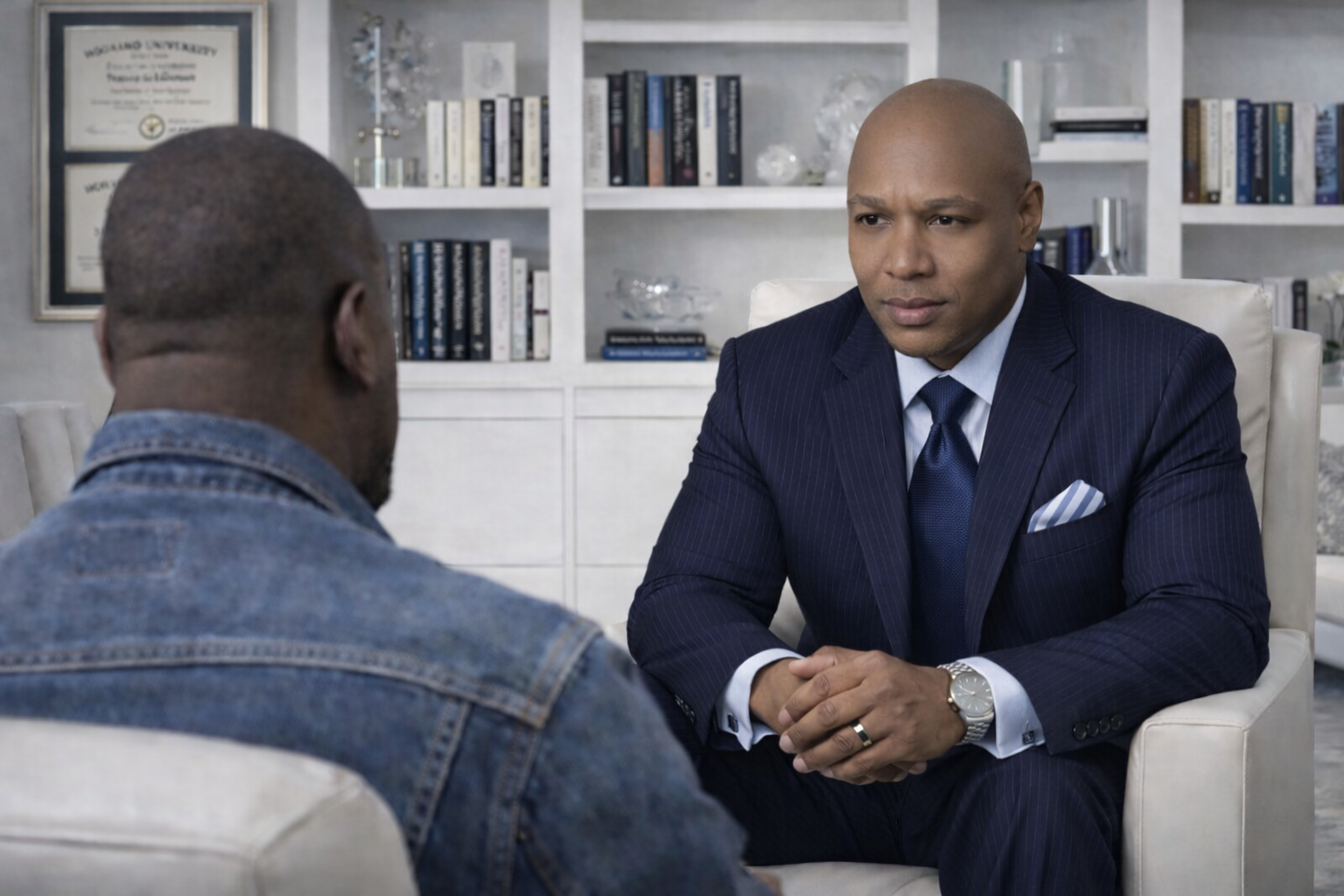
That reminder came recently during a session with a brotha who sat across from me in my office, shoulders forward, posture guarded in a way that suggested he had learned long ago not to take up too much space. To be still and remain quiet in the midst of internal pain and chaos. He was a Black man in his late forties or early fifties. A blue-collar worker. The kind of man who doesn’t arrive at therapy because he wants to talk about his feelings, but because something inside him has finally gone quiet enough to be heard.
He mentioned he was bothered and somewhat emotional. Disconnected. Tired. He didn’t dramatize it. He didn’t offer a story right away. He said, simply, that a lot had go in his life.
That’s where it always starts.
As we talked, the details came out slowly, not as a single narrative but as fragments. He was raised by a mother who was emotionally, verbally, and physically abusive. A woman who was present in the home but emotionally absent in ways that mattered. When he described her, his words were sharp at first, then softened almost immediately, as if he had said too much. “She did the best she could,” he added, quickly. His father was mostly absent, more concept than presence.
Later in life, he lost his beloved wife—the love of his life—to childbirth. She sacrificed her life so there only son could live. It was early and unexpected. There was no dramatic story attached to it. Just a sudden absence where something steady had been.
Now, years later, he struggles with his adult daughter who carries her own issues: addiction and homelessness. In and out of jail. In and out of contact. Choosing the streets over safety, drugs over family. A situation he cannot control, no matter how much he wants to.
At one point, I asked him which of these experiences hurt the most. It wasn’t a test. It was an attempt to understand where the pain lived. He answered quickly, but his body told a different story. His jaw tightened when he talked about his mother. His shoulders dropped when he talked about his daughter. When he talked about his wife, his voice softened, almost imperceptibly.
I’ve seen that pattern before.
Not only in patients—but in myself.
My own mother battled with heavy substance abuse. Crack Cocaine. Alcohol. Untreated mental health issues rooted in trauma she carried from her own childhood. Trauma that never had language, never had treatment, never had a place to land. I grew up in a home where love and instability coexisted, where care could turn unpredictable without warning. Emotional abuse wasn’t framed as abuse. It was framed as survival.
And like many Black sons, I learned early how to protect my mother emotionally. Guard her feelings while she shattered mine. I learned how to defend her story before I learned how to examine my own experience inside it.
In cities like Inglewood, CA and Oak Cliff, TX, mothers occupy a particular kind of space. They are often the backbone. The constant. The ones who held families together while carrying burdens no one acknowledged. We are taught to respect them, honor them, protect them. And often, that protection comes at a cost we don’t recognize until much later.
When my mother died, I didn’t only grieve her absence. I grieved the end of possibility. The possibility that things might have changed. That there might have been sobriety. Accountability. An apology. A conversation that could hold both love and truth at the same time. Death has a way of closing stories mid-sentence.
That kind of loss doesn’t resolve neatly. It doesn’t follow the clean arc people expect from grief. It lingers. It resurfaces. It shows up years later in unexpected places.
Listening to my patient talk about his daughter, I could hear something older moving through him. Not failure—though that’s often how men internalize it—but repetition. Pain traveling forward because it was never allowed to stop long enough to be felt. Trauma doesn’t need intention to repeat itself. It only needs silence.
This is the part of the conversation about Black and Brown men and mental health that often goes missing. We talk about resilience without asking what it required. We praise strength without examining how it was forged. We celebrate survival while ignoring what had to be buried to make it possible.
Men like my patient, and men like myself, were taught early that fragility was dangerous. That vulnerability never pays. That deep pain and trauma were things to manage privately, if at all. So we learned to deal with it, compartmentalize, and put that bull$%*% away so it never hurts us again. However, stored pain doesn’t heal. It leaks. Into depression. Into emotional distance. Into substance abuse. Into domestic violence. Into relationships that feel familiar instead of safe.
Even therapists aren’t exempt from that inheritance. Sitting with him reminded me that healing isn’t something you complete and move past. It’s something haunts and revisits you just when you begin to feel safe…again and again, and again. Each time with less illusions and more honesty!
Healing doesn’t require vilifying our mommas. It requires holding complexity without collapsing into denial. It requires being able to say two things at once without apology: I loved my momma deeply. And I was hurt by her profoundly by her pain. Both can be true. Both deserve space.
January 13 will always belong to my momma. But the days that follow NOW belong to me and to every man who has carried something similar… quietly. If this story feels familiar, it’s because it isn’t rare. It’s just rarely named.
Time doesn’t heal what silence protects. And strength isn’t measured by how much pain you can endure without complaint. It’s measured by the moment you decide that survival alone isn’t enough anymore.
Peace, Love and Light.
Dr. U
* Dr. Ifeanyi-Allah Ufondu is a clinical psychologist and founder of BroKin.Org, a mental health platform centered on the lived experiences of Black and Latino men. His work examines how grief, trauma, and loyalty move through families across generations. He practices primarily in Beverly Hills, CA and Dallas, Texas.